


The debate around UK versus UAE property investment has become increasingly relevant as investors seek the best opportunities to grow and protect their wealth. As global markets evolve, many investors are asking the same question: where should you invest?
To answer this question, it is important to compare key factors such as property prices, rental yields, taxation, investment processes, and long-term growth potential. While the UK has long been regarded as a mature and stable market, Dubai has emerged as one of the world’s fastest-growing real estate destinations.
Overview of UK vs UAE Property Investment
Both markets offer distinct advantages.
On one hand, the UK benefits from a well-established legal framework, strong financial institutions, and a long history of property investment. Cities such as London continue to attract domestic and international investors due to their global economic importance.
On the other hand, Dubai offers a highly investor-friendly environment, attractive tax policies, and strong economic growth. As a result, Dubai has positioned itself as a leading destination for international real estate investment.
Property Prices: Dubai vs London
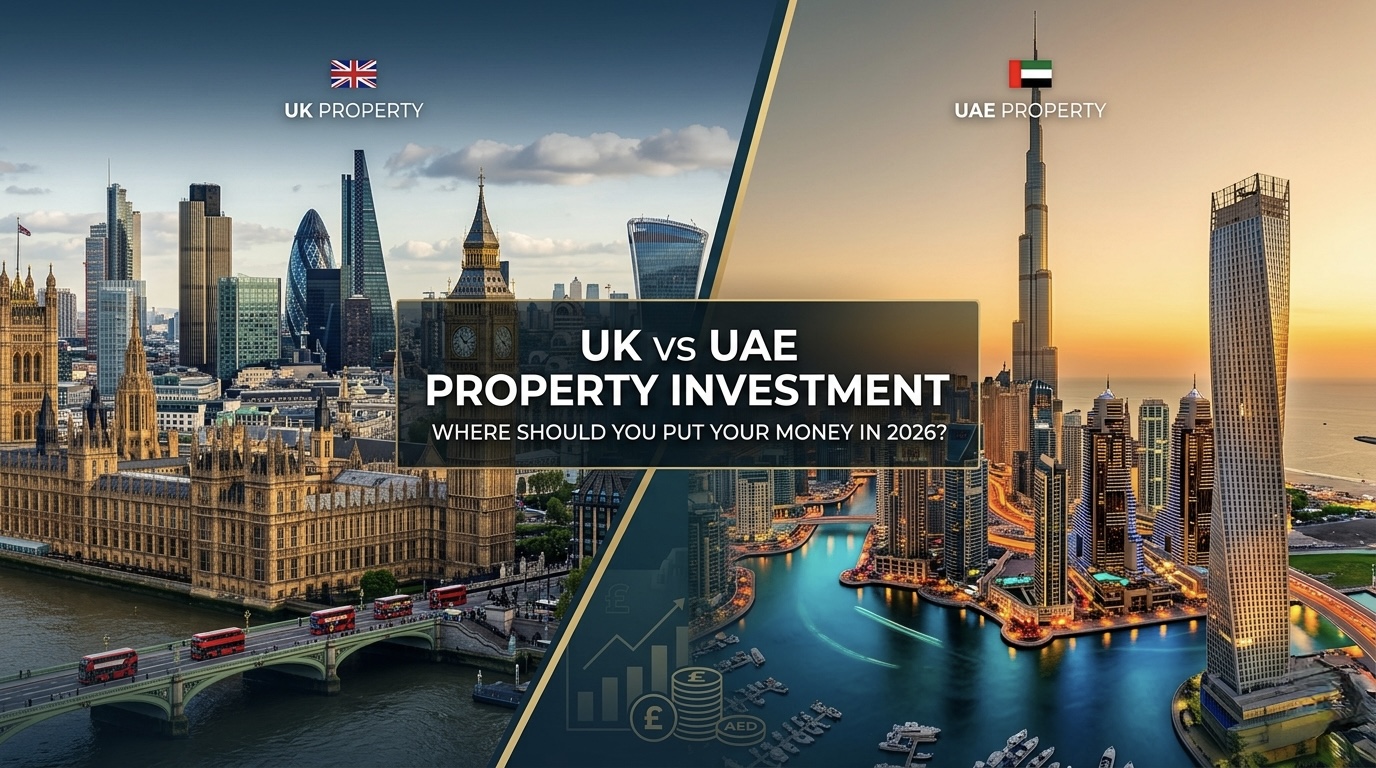
When it comes to affordability, one of the most significant differences between the two markets is property pricing.
London
- ‣ Higher property entry prices
- ‣ Less living space for the same investment amount
- ‣ Premium costs in central locations
Dubai
- ‣ More affordable luxury properties
- ‣ Larger living spaces
- ‣ Modern amenities and lifestyle-focused developments
Consequently, investors can often purchase a high-end property in Dubai for the same budget required to buy a significantly smaller unit in London. In other words, Dubai generally offers more value for money.
Rental Yield Comparison
Rental yield is one of the most important considerations for property investors.
UK
- ‣ Average rental yields typically range between 3% and 5%
- ‣ Taxation can reduce net returns
Dubai
- ‣ Average rental yields often range between 6% and 10%
- ‣ No income tax on rental earnings
Therefore, Dubai is often considered more attractive for investors seeking strong cash flow. Furthermore, the absence of income tax allows investors to retain a greater share of their rental income. As a result, the rental yield comparison tends to favour Dubai.
Taxes and Investment Costs
In addition to rental returns, taxation plays a major role in determining overall profitability.
UK
- ‣ Income tax on rental income
- ‣ Capital gains tax on qualifying property sales
- ‣ Stamp duty and additional transaction costs
UAE
- ‣ No annual property tax
- ‣ No personal income tax on rental income
- ‣ No capital gains tax for individuals
By comparison, the UAE offers a significantly more tax-efficient investment environment. For this reason, many international investors are increasingly exploring opportunities in Dubai’s property market.
Investment Process
The purchasing process also differs considerably between the two countries.
UK
- ‣ More complex legal procedures
- ‣ Longer transaction timelines
- ‣ Multiple stages involving solicitors, lenders, and surveys
Dubai
- ‣ Streamlined purchasing process
- ‣ Transparent regulations
- ‣ Strong government support for foreign investors
Moreover, Dubai has implemented several initiatives designed to simplify property transactions and attract global capital. As a result, investors often experience a faster and more straightforward buying journey.
Popular Investment Areas in Dubai
In particular, several established communities continue to attract strong investor interest:
These locations benefit from strong rental demand, premium lifestyle offerings, and long-term appreciation potential. Consequently, they remain among the most sought-after investment destinations in Dubai.
Risks to Consider
However, no property market is without risk.
UK Risks
- ‣ Higher taxation
- ‣ Slower capital growth in some regions
- ‣ Rising borrowing costs
Dubai Risks
- ‣ Greater exposure to market cycles
- ‣ Supply fluctuations in certain segments
- ‣ Dependence on international investor demand
Therefore, investors should carefully assess their financial goals, risk tolerance, and investment horizon before making a decision.
Final Verdict: UK vs UAE Property Investment
Ultimately, the right choice depends on your investment objectives.
If your priority is:
- ‣ Long-term market stability → UK
- ‣ Higher rental yields → Dubai
- ‣ Tax efficiency → Dubai
- ‣ Growth potential → Dubai
Overall, Dubai offers a compelling proposition for investors focused on maximizing returns and benefiting from a tax-efficient environment. Meanwhile, the UK may appeal more to those seeking the familiarity and stability of a mature property market.
Conclusion
In conclusion, the comparison between UK and UAE property investment highlights two distinct opportunities. While the UK offers stability, transparency, and a well-established investment environment, Dubai provides higher rental yields, favourable tax treatment, and strong growth prospects.
Looking ahead, Dubai is expected to remain a key destination for international real estate investors. Therefore, for those seeking to enhance returns and build long-term wealth, Dubai continues to stand out as an increasingly attractive option.
Read More: Step-by-Step Guide to Buying Property in Dubai for Expats

 Dubai Investment Park (DIP), Dubai








 Dubai Investment Park (DIP), Dubai